
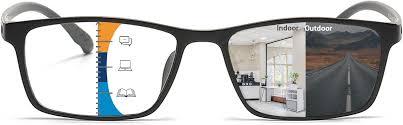
For people who move constantly between indoor tasks and outdoor activity, Progressive Lens With Photochromic can simplify daily vision by combining distance correction, reading support, and light-responsive convenience, while Progressive Lens With Photochromic also helps reduce the need to switch between separate pairs of glasses. That combination matters in modern life, where commuting, screen work, reading, and casual outings often happen within the same day.
A More Natural Way to Handle Changing Light
One of the most practical advantages of adaptive eyewear is its ability to respond to changing brightness without demanding extra attention from the wearer. A lens that darkens outdoors and clears indoors creates a smoother transition between environments. Instead of carrying sunglasses, reading glasses, and everyday eyeglasses separately, users can rely on one pair that handles multiple needs with less effort.
This matters especially for people whose routines change quickly. A morning may begin with email and screen time, continue with errands in bright sunlight, and end with reading at home. The less a person has to think about vision changes, the easier it becomes to stay focused on work, conversation, or travel. That convenience is not only practical; it also improves the overall wearing experience.
Why Progressive Design Matters in Daily Use
Progressive optics are valuable because they support several viewing distances without visible lines. That means the wearer can look at a phone, then a laptop, then a road sign without changing glasses. For many people, the biggest benefit is not just correction but continuity. Vision feels more stable when the transition between near, intermediate, and far distances happens smoothly.
This type of design is especially helpful for middle-aged users who need assistance with reading but still want comfortable distance vision. It also appeals to people who work at desks, drive often, or spend time in mixed visual environments. In those situations, the lens becomes part of a seamless routine rather than a separate tool that interrupts the day.
Material Quality and Lens Performance
Lens performance depends on more than design alone. Material quality affects weight, clarity, durability, and comfort, all of which influence how often someone wants to wear the glasses. Lighter constructions are easier on the nose and ears, while strong surface finishes help the lens maintain its appearance through repeated cleaning and daily handling.
A good coating system can also improve the user experience in subtle but important ways. It can reduce distracting reflections, preserve optical clarity, and support a more relaxed visual feel in bright indoor or outdoor settings. When these features are balanced correctly, the lens works quietly in the background, allowing the wearer to focus on life instead of on the glasses themselves.
Thinkeyoptical and User-Focused Development
Thinkeyoptical approaches eyewear development with attention to practical wearability and visual comfort. In products like these, the details matter: how quickly the lens reacts to light, how naturally the viewing zones are arranged, and how well the final pair supports long hours of use. That kind of careful development helps make the product feel dependable in real-world settings.
For many wearers, comfort is as important as optical performance. If the glasses feel heavy or awkward, the user may hesitate to wear them consistently. But when a product is light, balanced, and visually effective, it becomes easier to keep on throughout the day. That consistency improves the value of the eyewear and makes it more useful over time.
Style, Convenience, and Everyday Confidence
Eyewear has become a visible part of personal style, and many users now expect function and appearance to work together. A well-chosen frame can make the glasses feel professional, modern, or relaxed depending on the setting. This is one reason adaptive eyewear continues to gain attention: it solves practical problems while still supporting a polished look.
Convenience also influences confidence. People are more likely to wear glasses that fit comfortably, look good, and perform reliably across different tasks. When the product matches the wearer's pace of life, it stops feeling like a burden and starts feeling like a natural extension of daily habits. That shift is important because consistent use is what gives the eyewear its real value.
The Future of Flexible Vision Solutions
As optical technology continues to improve, future lens solutions will likely become even more precise and personalized. Better materials, smoother transitions, and more responsive coatings may all contribute to a more comfortable experience. At the same time, sustainability will remain important as users look for products that last longer and are made with care.
The direction of the industry is clear: people want eyewear that adapts to them, not the other way around. Flexible vision solutions will keep growing in value because they fit the realities of modern life. For those exploring more about today's optical options, https://www.thinkeyoptical.com is a natural place to begin.

 English